Wednesday, February 24, 2010

Intermediate Drawing and Painting Final Reflection

Here we are at the end of the course...you have made a variety of different kinds of drawings and paintings over the past few months. How would you sum up your artistic experience this term? On your blog share what have you discovered and learned about:
  • the world of drawing and painting in general.
  • your technical abilities in drawing and painting.
  • your interests in terms of subject matter and content...what you have to say as an artist.
This term has been a wonderful artistic experience for me, and a not so great one. Wonderful because I learned how I work best in art which is alone I am just too easily distracted. Also I learned to stop trying to make an object in a picture and instead just do the colors and shading the object would follow. I also learned that no matter how many ideas I got I should just stick with one or else I would never finish the project, and that the most interesting idea is not always the best one. I also learned that liking the project is not as important as finishing it. This term was not so great for all those same reasons, I only learned the lessons from making the mistakes. The biggest thing I learned about the world of drawing and painting in general is that it is not what I had originally thought. I had always viewed art as something a bit less serious, something that was more a side project, now I know that art is a lot more serious(again a lesson learned by making the mistake). As far as what I like to make, I have learned I like making art that is more wild, the more fun, but also the longer it will take. About my technical artistic abilities, I learned I am a pretty decent color mixer, can be good at placing objects, and that shading objects is not as hard as I had always thought.

Friday, January 8, 2010

Artist-in-Residence: Alexander DeMaria

In response to the work I can only think of one word: WOW the detail is incredible. The art is so well done and intricate. The detail work is what makes this art pop and at the same time what also draws me to looking at the image as a whole.

Question: Where do you get the inspiration for your work?
Answer: They all build on each other.
Question: What do you do if you make a mistake?
Answer: I cover it up somehow.

Wednesday, December 16, 2009

Drawing from observation skills.

We've covered a lot of territory in our first two and a half weeks together.
Take a look at the drawings you've made so far and think about the skills it took to create them.
On your blog describe several of these skills (at least 3) and how you put them to use in your drawings.
Three of the skills I needed to do these assignments I needed to be patient, be attentive to detail and be creative. To make these "masterpieces" I needed to be patient enough to start over like with the table scape or be willing to work on one drawing for a long time like with the black and white table with pine cones on it. I also needed to be attentive to detail so one object was in the right spot like with the table or the shading of the crumpled paper drawing or even the details of the textures in the zoom drawing. I also had to be creative for the black and white table drawing to think of how to do the textures.

Wednesday, December 2, 2009

Collaborative Drawing

How did you "deal" with each drawing you approached?
I first would look at the drawing and the objects and figure out what seemed off. Then I gently tried to fix the problems while keeping the bulk of the drawing the same.
What was the process for "correcting" what you saw?
In the drawings what seemed off was the spacing of the objects. To fix the spacing I would play around with the spacing of the logs, which took up most of the space of the drawing. By doing that the spacing would seem better while the bulk of the drawing was the same. There also was something missing or something that was seen that really should not be seen and that only needed some minor erasing or a few lines.
How did it feel to return to your drawing at the end and to see what others had done to it?
What did you have to do to finish your drawing?
After looking at my drawing and seeing what others had done, I felt better than I thought I would, because I knew that I had done the same thing to other people's drawings. To finish my drawing I mainly had to flesh out the skeleton of the objects and fix angles.

Tuesday, December 1, 2009

Pre-assessment

The drawing the felt more natural to me was the drawing from observation even though the imaginative drawing was more fun. It seemed more natural to me because to draw something I need an image of it in order to draw it.

Wednesday, May 27, 2009

END OF THE YEAR REFLECTION


My greatest accomplishment in art is clearly the amazing glaze job on my clay sculpture.
My biggest struggle has been putting my clay sculpture back together and making it amazing again. In fact it is so amazing it deserves another picture
I have made the most progress in art on drawing the proof is in the sketch books

Clay Sculpture

The most successful aspect of my amazing sculpture is the glazing job which is so amazing that it makes me cry.
I would not do anything diferently if i were to do this again because the cracks add character to my sculpture.

Family Portrait


To show my family I decided to show who goes where and when. Like my oldest sister who moved into college and me who goes all over.
The biggest strength in my family portrait is the footprints they accuratly show my family

Block Print


I feel WONDERFUL about my block print it looks wonderfulthe line up is great the only problems I had were mixing the colors I could not get brown or a sandy orange the orange is off and the brown only finally showed up with gold and red

Sunday, May 17, 2009

Found Object Sculpture

To make this sculpture I had to figure out what to make and what I could use to make what and how to use what I had.
This magnificent Cash Register represents my sister she is rarely wrong, good with money and is good for business. Unlike a cash register it is not easy to push my sister's buttons and also unlike a cash register my sister is full of emotion.

POD: Principles of Design Notebook

In this book I am trying to tell the story of a little girl who got lost and was found by a small dog who took the little girl back to her father. The little dog belongs to a kind old woman.
To show the story I had to use a lot of cut outs from the xeroxes to show motion i had to take say one half of the xerox and put it on the other side.
The principles of design can be used to show a story by helping show the emotion in it like radial symmetry for being alone and also an image being unbalanced to show the same thing.

Self Portrait

The 2 aspects of my personality shown are a calm and passive and relaxed side of me and the other is a hot headed stubborn willful me.
 The struggles I had when painting this were my hair and the grid getting the grid to work out was a challenge because things that seem small are really much bigger on your face and I wanted to make what seemed small or in the middle be there when it really was bigger and more to the side. Also I had a struggle with mixing the colors to be right like mixing black is not an easy task. Also I struggled with figuring out what aspects of my personality I wanted to show. There was also the the time as shown I didn't get to putting on a nose that was easily visible. 
If I were to do this differently I would add more of the face like the nose and also try to put some sort of texture in the hair.

Monday, April 27, 2009

Scuplture Texture

unknown.jpg

Title: Standing Buddha offering Protection

Sculptor: Unknown

Substance: Red Sandstone

Time: Late 5th century

Area: India

How texture is used: Texture here is used to show the different articles of clothing and changes between substances like hair and skin. 

Why and where are different textures: The three textures are the knobbly ones on the head, the smooth skin and the wavy clothes. These textures are used to define the hair skin and cloths apart from each other. The knobbly hair because that his how the hair looked, smooth skin because the skin is the smoothest of the textures and finally the wavy clothes to show the clothes. The clothes may not have been wavy, but this is a good way to make the clothes look. 

Wednesday, April 22, 2009

Sculpture


Title: Man on a Bench
Sculptor: Duane Hanson
Time: 1997-1998
Area: ????
Story: The story is of a man who is sitting on a bench waiting for something.
Choices that help tell the story: It is made in the  "Hyper-real" style. This makes the sculpture look real my first thought when seeing this was it was a picture of a man sitting on a bench with a manila envelope in his hand. This choice makes the story seem very real. Also the man's expression is a very tired which makes it seem like he has been waiting for a very long time and just wants to sleep. After looking at it  for a very long time some of the things like the shape of his right hand and some of the shadows are wrong and I can tell it is wrong.

PS. Sorry it is up late i didn't realize i didn't post it on monday i was sick

Monday, April 6, 2009

Family/Changes over time

Title: The Griffon Family
Artist: Seth Macfarlane
Time: 2005
Country: USA


Title: Charles IV of Spain and his Family
Artist: Fransico Goya
Country: Spain
Time: 1800-1801


Differences: In the First the family is fighting and arguing. In the Second the family is orderly and polite looking.  In the first there are people fighting, scolding and being oblivious. The second is orderly neat  and presentable the all know what is happening and are in their best clothes for the occasion. In the first there are people in their messy whatever cloths and in play clothes clearly not wanting to be there.
Vision: In both the artists are trying to portray a family, one is trying to portray an accurate family and one is trying to show a family as it should be. In the first the family is as they always are, while the second does what people at the time thought they always were. 
My mistake I mixed up the assignments but I think this can still count for both of them if not please tell me 

Monday, March 9, 2009

Nighthawks

Title: Nighthawks
Artist: Edward Hopper
Country: USA
My First Impressions: At first looking at it I see that this is a night scene where there is a man and a woman possibly going out in a bar and the bar it seems is almost closing. It seems late. I feel like I have seen this before but can not place it.
What I learned: I have learned that this is a rather famous painting and that Edward Hopper is a wonderful Artist.
Unity: The Unity in this comes from the lack of balance toward the side with the bar. The contrast of the bright bar and the dark outside. There are leading lines starting from the white to the black line down the middle. From the middle it goes to the grouped canisters and from there to the bar man then to the couple the man is staring at. The man on the side seems almost an after thought because he has no unity to the others. The others how ever feel very unified because they almost look like they are having a conversation.

Wednesday, February 25, 2009

Reflection

If I could do one of the projects again it would be the collage, because I think I would do it better. Of all the artists we researched I think Sara Sze has the most interesting art, I did not do her for sculpture only because I could not find enough information about any of her works. Her work is very interesting because it is  so strange.

Thursday, February 19, 2009

Sculpture


Title: Gridlock
Artist: Chakaia Booker
Country: USA
Time: 2008
My First Impressions: At a first look this apears to be a worm of some sort made of metal, but looking  for longer it could also be like the title suggests high traffic with every thing crammed in as close together as possible.
What I learned: After reading it does not say what it is but my second guess seems to be right, this is made of Tire and Metal, is one of 10 sculptures in an exhibit this exhibit is an entire city.

Monday, February 9, 2009

Works of Art I know


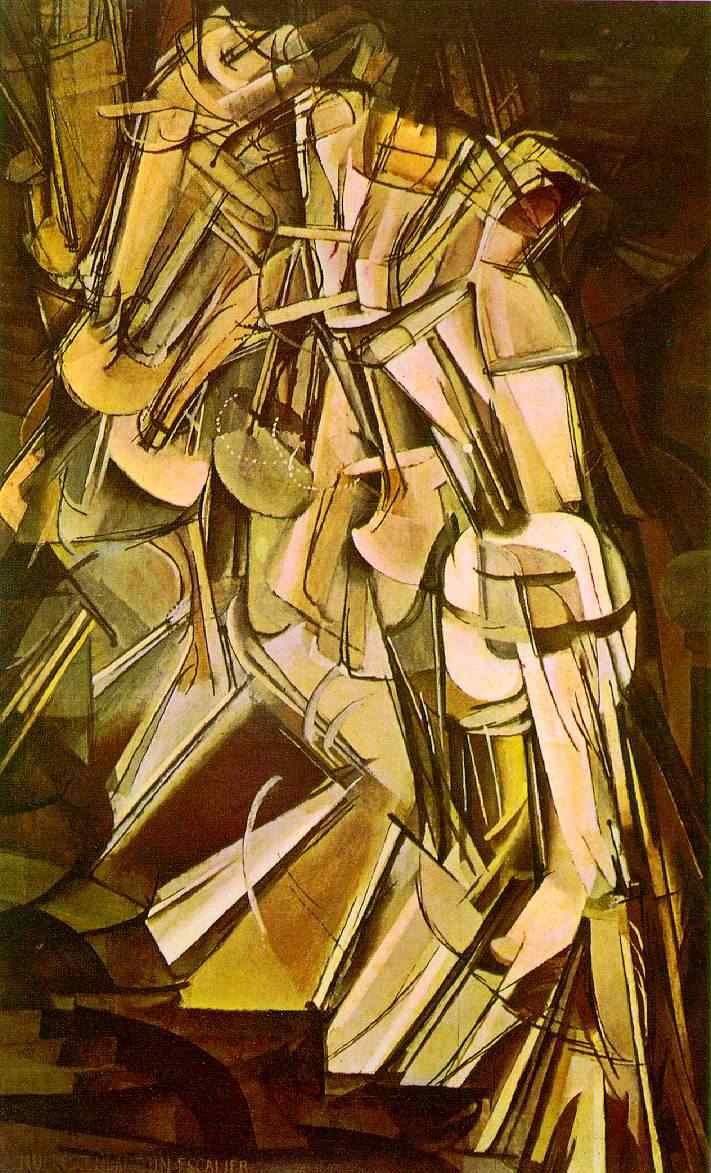
Title: Nude Descending a Staircase

By: Marcel Duchamp

Country: France

Time: 1912

My First Impressions: This looks like a painting of some sort of a robot walking down some invisible stairs. The figure seems metallic and lifeless. It looks like the golden figure is moving so fast that it is seen multiple times. The painting seems to be cubism.

What I have Learned: I have learned that Marcel made this painting from a picture of a naked woman descending a staircase. He made it with cubism, the title was so provacative that there were demands for him to either change the title or not submit it to a galery.

Monday, February 2, 2009

Portraits Blog

By: Vincent Van Gogh
Title: (Given title not sure about the actual one) Vincent Van Gogh's Self-Portrait
Country: Paris, France
My First Impressions: When I first looked at this I saw that he looks almost sad and happy, he also has a very perplexing look in his eyes something that I can't quite identify as anger or fear or happiness or anything. He seems almost confused, also I see that he is painted in thick brush strokes and light dainty ones but big thick heavy strokes stand out the most. The look in his eyes and face is something that is made partly with the colors and also with the shadowing. The shadowing makes it hard to see exactly what his face is doing because the shadows say on thing and the image itself say another.
What I learned: I learned that Van Gogh painted somewhere around 30 self portraits in a short span and that of them all this one has a unique color palette containing the entire scheme while others were mostly light and hot colors.